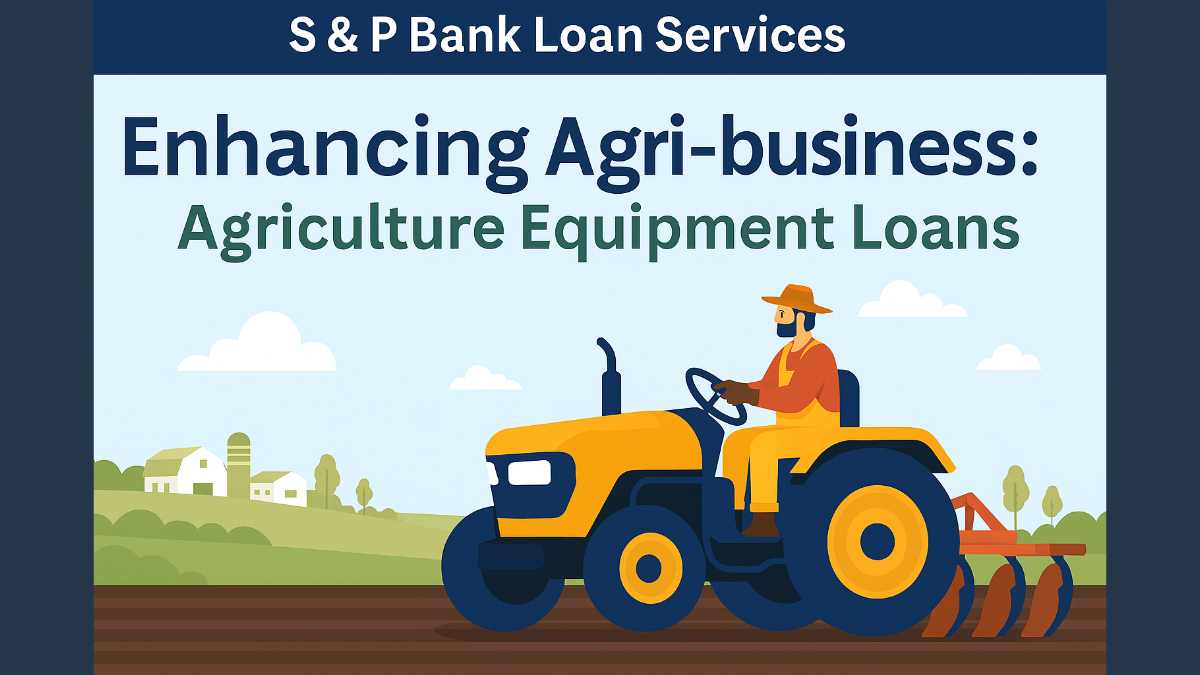
Enhancing Agri-business: Agriculture Equipment Loans
In this article
- Introduction to Agriculture Equipment Loans
- Benefits of Agriculture Equipment Loans
- Eligibility Criteria
- Types of Agriculture Equipment Loans
- Loan Application Process
- Interest Rates and Repayment Terms
- Government Schemes and Incentives
- Risk Management and Insurance
- Financial Planning for Agri-business
- Role of Expert Consulting
- Frequently Asked Questions
Enhancing Agri-business – Agriculture plays a critical role in the economy. Farmers require modern equipment to improve productivity. Agriculture equipment loans provide financial support to acquire tractors, harvesters, irrigation systems, and other machinery. At S & P Bank Loan Services, we guide clients to access loans efficiently and build successful agri-businesses.
Enhancing Agri-business: Agriculture Equipment Loans: S & P Bank Loan Services
Introduction to Agriculture Equipment Loans
Agriculture equipment loans are specialized credit products designed for farmers and agribusinesses. These loans cover the cost of machinery, tools, and technology essential for modern farming. They help farmers increase efficiency, reduce manual labor, and expand operations.
Banks and financial institutions offer these loans at competitive interest rates. They also provide flexible repayment options. Farmers can choose loan tenures that align with crop cycles and revenue patterns. Financial guidance ensures borrowers make informed decisions.
Benefits of Agriculture Equipment Loans
Agriculture equipment loans offer several advantages. First, they provide access to modern machinery without large upfront costs. Second, they improve productivity by reducing time and labor required for farming operations.
Third, these loans enhance profitability. With better equipment, farmers can increase crop yield and reduce wastage. Fourth, they encourage technological adoption. By using advanced tools, farmers stay competitive in the market.
Moreover, banks often offer subsidies and incentives under government schemes. These benefits lower the effective cost of borrowing and encourage investments in agriculture.
Eligibility Criteria
Eligibility for agriculture equipment loans depends on multiple factors. Banks typically consider the farmer’s age, credit history, land ownership, and income stability. They also review project proposals and expected returns from the investment.
New farmers or small-scale operators may need guarantors or collateral. Financial advisors help prepare documents, credit reports, and business plans. Proper documentation increases loan approval chances.
Types of Agriculture Equipment Loans
Agriculture equipment loans vary according to purpose and equipment type. Term loans finance high-value machinery like tractors and combine harvesters. Short-term loans cover seasonal needs such as irrigation pumps or planting tools.
Leasing options are also available. Under leasing, banks or financial institutions retain ownership while farmers pay a fixed rent. Leasing reduces upfront expenses and allows access to advanced equipment.
Loan Application Process
The loan application process involves several steps. First, farmers submit a detailed application with identity proof, land records, and financial statements. Second, banks evaluate the borrower’s eligibility, income, and repayment capacity.
Next, property valuation or equipment cost assessment may be conducted. Finally, the bank approves the loan and disburses funds. Farmers can then purchase or lease equipment. Expert guidance ensures smooth processing and avoids delays.
Interest Rates and Repayment Terms
Interest rates on agriculture equipment loans vary by lender, loan amount, and repayment tenure. Banks offer fixed or floating rates depending on policy and market conditions.
Repayment schedules are structured according to crop cycles. Seasonal income patterns influence EMI amounts. Flexible repayment terms prevent financial stress and maintain liquidity for operational expenses.
Subsidies under government schemes, such as the interest subvention program, reduce effective interest rates. Farmers benefit from lower costs and enhanced cash flow.
Government Schemes and Incentives
Several government programs support agriculture equipment financing. Subsidies, grants, and concessional loans make modern machinery affordable.
For instance, the Ministry of Agriculture provides financial support for small and marginal farmers. State-level initiatives also offer incentives for adopting mechanized farming. Legal and financial advice helps farmers leverage these schemes effectively.
Risk Management and Insurance
Investing in agriculture equipment involves risk. Equipment may be damaged due to accidents, weather, or theft. Banks often require insurance coverage for financed machinery.
Insurance policies protect farmers from financial loss. They ensure continuity of operations even in adverse conditions. Risk management advice ensures that borrowers remain financially secure and sustainable.
Financial Planning for Agri-business
Agriculture equipment loans should be part of a comprehensive financial plan. Farmers need to evaluate projected returns, operating costs, and loan repayment capacity.
Budgeting ensures that loan obligations do not disrupt day-to-day operations. Financial experts guide in selecting suitable loan products, managing cash flow, and optimizing resource allocation. This strategic planning strengthens the overall business model.
Role of Expert Consulting
Financial consulting firms like S & P Bank Loan Services provide essential support. We assist in loan application preparation, eligibility assessment, and documentation.
We also advise on suitable machinery, financing options, and government incentives. Expert guidance minimizes errors, accelerates loan approval, and maximizes benefits. Farmers gain confidence to expand operations and adopt modern technology.
Frequently Asked Questions
What are agriculture equipment loans?
Agriculture equipment loans are specialized financial products for farmers. They provide funds to purchase tractors, harvesters, irrigation systems, and other machinery. These loans help modernize farming operations and increase productivity.
Who is eligible for an agriculture equipment loan?
Eligibility depends on factors such as age, credit history, land ownership, and income stability. Banks also review project proposals and expected returns. Small farmers may require collateral or guarantors to secure the loan.
What types of agriculture equipment loans are available?
There are term loans for high-value machinery and short-term loans for seasonal equipment. Leasing options allow farmers to use machinery without upfront costs. Both options reduce financial strain while improving farm efficiency.
How do government schemes support agriculture equipment loans?
Government schemes provide subsidies, concessional interest rates, and grants. Programs at national and state levels make modern equipment affordable. Farmers can leverage these incentives to reduce loan costs and maximize returns.
Why is financial planning important when taking an agriculture equipment loan?
Financial planning ensures that loan repayments align with crop cycles and cash flow. It helps manage operating costs, optimize investments, and reduce financial stress. Expert advice ensures sustainable growth and successful agri-business operations.
Conclusion
Agriculture equipment loans empower farmers and agribusinesses to modernize operations. They improve productivity, increase profitability, and encourage technological adoption.
With proper financial planning, risk management, and expert guidance, farmers can maximize returns and build sustainable businesses. At S & P Bank Loan Services, we provide comprehensive support to secure loans, optimize investments, and enhance agri-business growth. By leveraging loans, incentives, and consulting expertise, farmers can build their future together and achieve long-term success in agriculture.
Read More